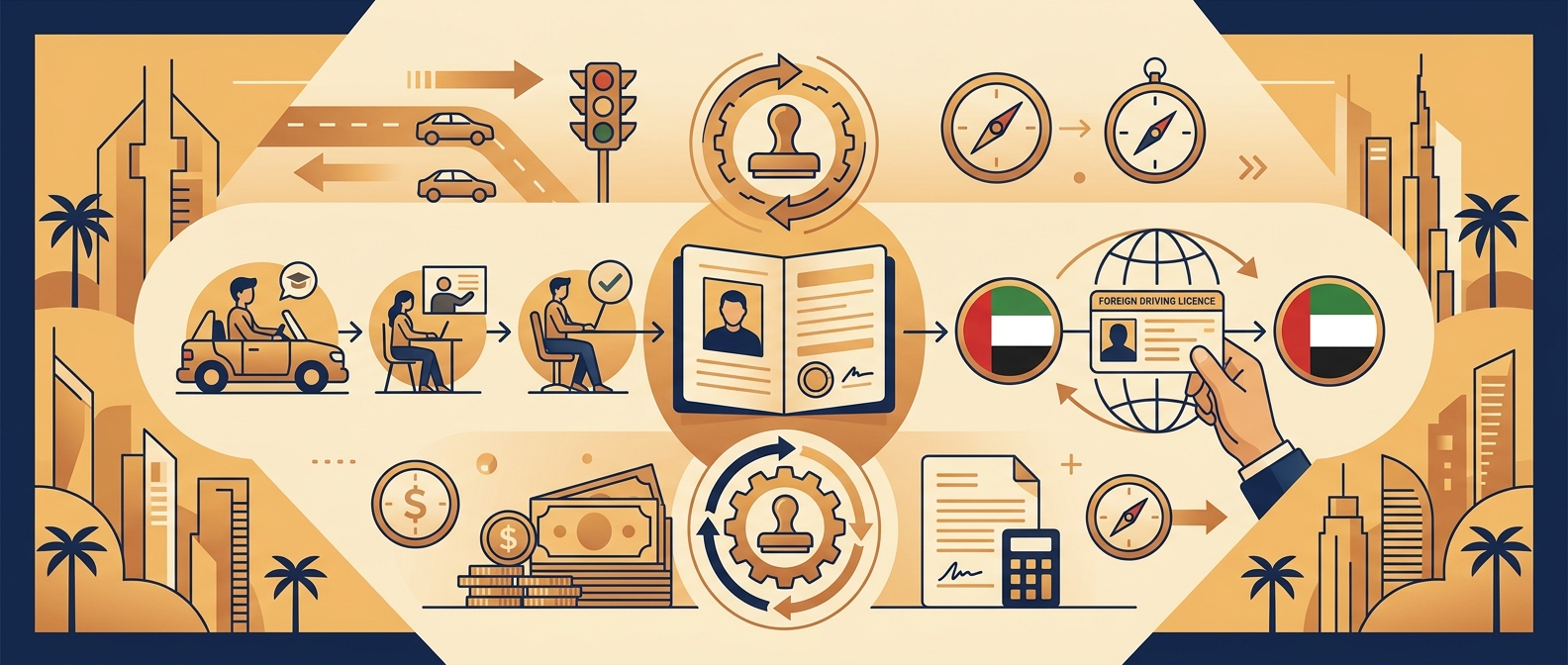
Once you hold a UAE residence visa, your home-country driving licence is no longer valid for driving here, and an international driving permit will not save you. Every resident who wants to drive needs a UAE licence. The good news: if your licence was issued by one of roughly 50 approved countries, you can exchange it directly in a single visit, no lessons or tests required. Everyone else goes through driving school, a process that costs real money and tests real patience. This guide covers both routes as they stand in 2026.
Route 1: Direct licence exchange (the lucky ~50 countries)
The UAE recognises licences from around 50 countries for direct exchange (technically "transfer"). The list includes:
- All GCC states (Saudi Arabia, Kuwait, Qatar, Bahrain, Oman)
- Most of Western Europe, UK, Ireland, Germany, France, Italy, Spain, Netherlands, the Nordics, Switzerland, and most other EU members
- North America, United States and Canada
- Australia and New Zealand
- Others including Japan, South Korea, Singapore, Hong Kong, South Africa, Türkiye, China, and several more
The exact list is maintained by the Ministry of Interior and applied by each emirate's licensing authority (RTA in Dubai), so check the current list before assuming; countries are added periodically. Note two common catches:
- For some nationalities, your passport nationality must match the licence-issuing country (holders of, say, a third-country passport with a UK licence may face extra requirements or be refused exchange).
- Licences from a few countries require a legal translation or embassy letter if not printed in English or Arabic.
The exchange process in Dubai (RTA)
- Eye test at any approved optician or typing centre; it takes ten minutes and costs around AED 130-150.
- Apply via the RTA website, RTA app, or a customer happiness centre with: Emirates ID, passport + residence visa copy, your original home licence (plus translation if needed), and the eye test result (usually uploaded electronically by the optician).
- Pay the fees, expect a total of around AED 870 for the licence issuance and file, plus the eye test and any knowledge fees. Budget roughly AED 1,000-1,100 all-in.
- Your card is issued on the spot or delivered by courier; a digital version appears in the RTA/UAE apps immediately.
The whole thing can genuinely be done in an afternoon. Some categories (motorcycle, heavy vehicle) are not always transferable even from approved countries.
Route 2: Full driving school (everyone else)
If your licence country is not on the list (this covers India, Pakistan, the Philippines, Egypt, Nigeria, and most of Asia and Africa), you must complete the full process at an approved driving institute (in Dubai: Emirates Driving Institute, Galadari, Belhasa, Eco Drive, Drive Dubai and others).
The steps
- Open a driving file at the school with your Emirates ID, visa copy, photos and eye test. File opening plus RTA fees typically costs around AED 500-1,000.
- Theory lectures: 8 classes covering rules and signage, followed by the RTA theory test (computer-based, available in many languages, around AED 200 per attempt).
- Practical classes: this is where the money goes. If you already know how to drive, you may be assessed and assigned the minimum; if you hold a licence from a non-exchange country for 2-5+ years you can qualify for reduced hours. A typical new or lightly experienced driver is assigned 15-20 hours, at roughly AED 100-180 per hour depending on school, transmission and peak/off-peak timing.
- Internal assessments: schools run their own smart yard/parking tests (garage parking, hill stop, etc.) before releasing you to RTA tests.
- RTA road test: an examiner rides with you (often with other candidates in the car) for a short assessment. Each attempt costs around AED 200-300; failing usually means mandatory additional classes before you can rebook.
- Licence issuance: around AED 300 once you pass.
Realistic total cost
Schools advertise packages from AED 2,500-4,000, but almost nobody escapes at the advertised price. With retests, extra classes and fees, a realistic 2026 budget is AED 4,500-7,000, and drivers who fail the road test two or three times can cross AED 8,000-10,000. Timelines run from six weeks (fast-track, off-peak) to four or five months.
About failing the road test
Do not take a first-attempt failure personally; it is close to a rite of passage. Examiners in the UAE are famously strict about mirror checks, shoulder checks, full stops and hesitation at roundabouts, and pass rates on the first attempt are low, many candidates pass on the second or third try. Budget mentally and financially for at least one retest, and treat the mandatory extra classes as polishing rather than punishment.
The costs of actually driving: Salik, fuel, parking
A licence is only the start. If you are buying, our guide to buying a car in the UAE covers new, used and the paperwork. Owning a car in Dubai means:
- Salik (road toll): AED 4-6 per gate crossing depending on time of day, with several gates on Sheikh Zayed Road and key crossings. A daily SZR commuter can spend AED 200-400+ per month on tolls alone; see our breakdown of Salik, parking and petrol costs.
- Fuel: petrol prices are adjusted monthly but remain cheap by global standards; a full tank on a mid-size sedan typically costs around AED 150-200.
- Insurance: roughly 2-4% of the car's value per year (higher for new licence holders; many insurers load premiums for licences under one year old).
- Registration and testing: annual renewal around AED 400-600 plus inspection for cars over three years old.
- Parking: public paid zones run AED 2-6 per hour; many employers and buildings charge for spaces.
Car vs public transport: the honest comparison
Dubai's Metro, trams and buses are clean, cheap and air-conditioned. A monthly Nol pass costs around AED 350 for all zones, versus AED 1,500-2,500+ per month for a modest financed car once you add fuel, Salik, insurance and depreciation. If you live and work near the Red or Blue Line, you may not need a car at all. If your job involves site visits, or you live in a villa community, a car is close to unavoidable, and taxis/ride-hailing at AED 2+ per km add up fast as a full-time substitute.
Book your theory test early and do the eye test the same week you open your file. The paperwork steps, not the driving, are what quietly add weeks to the process.