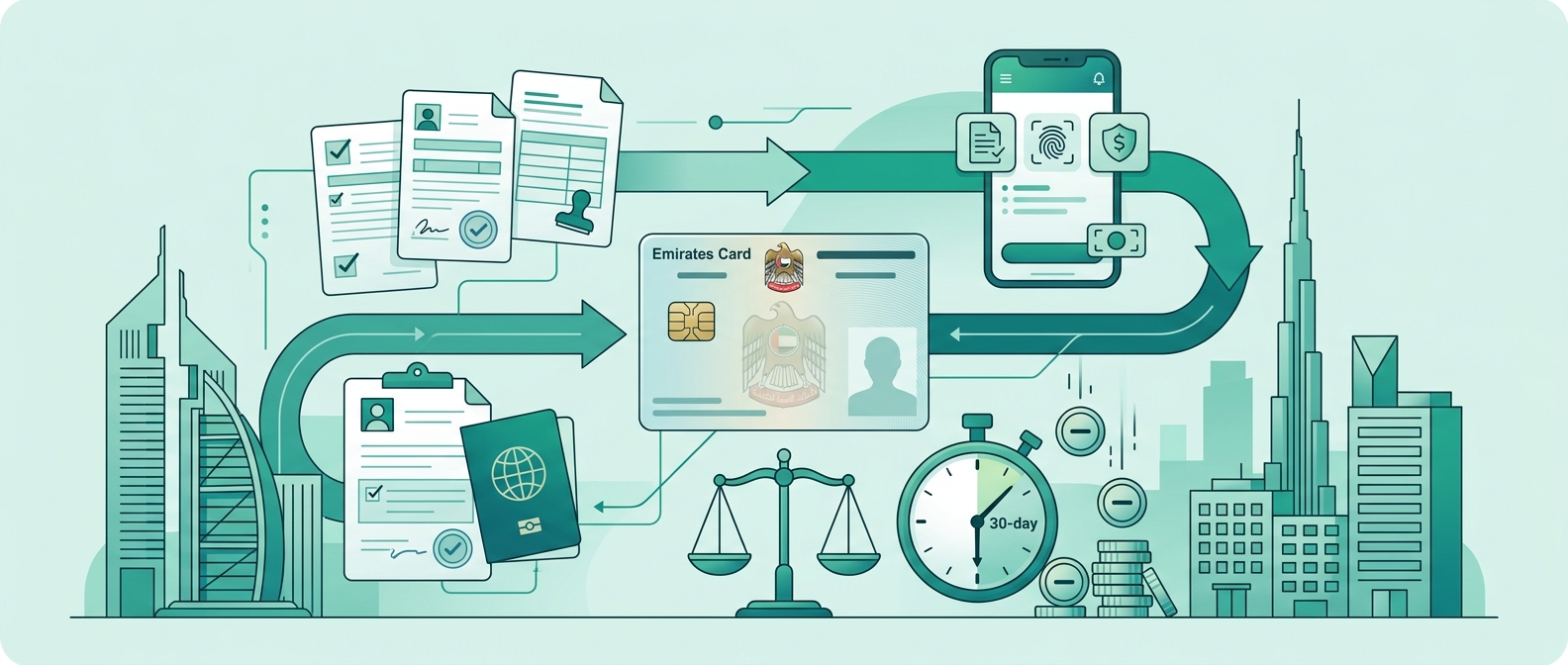
The first month in Dubai is a paperwork sprint. Almost everything (renting a flat, opening a bank account, getting broadband) depends on your Emirates ID, and the Emirates ID depends on your residence visa being processed. Get the sequence right and the whole thing takes two to three weeks; get it wrong and you'll spend your first month bouncing between offices.
Here is the order that actually works, week by week.
Week 1: residency paperwork first, everything else second
If you arrived on an employment entry permit, your employer's PRO (public relations officer) drives this process. Your job is to show up quickly whenever they need you.
- Entry stamp / status activation. Your entry permit is activated when you land (it's all digital now, no physical stamp needed at most entry points).
- Medical fitness test. A blood test and chest X-ray at an approved medical centre. Standard results take a couple of days; paid fast-track options return results within 24 hours. Cost is around AED 300-700 depending on speed, usually covered by your employer.
- Emirates ID biometrics. Fingerprints and photo at an ICP or Amer centre (only needed if it's your first UAE ID). Book this the same week as the medical.
- Labour contract signing. Your MoHRE contract must match your offer letter, check the salary breakdown, notice period and job title before signing. This is what your work permit, and later your gratuity, are based on.
- Residence visa issuance. Once medical and biometrics clear, your two-year residence visa is issued digitally and your Emirates ID card follows by courier or collection, typically within one to two weeks.
While that grinds along, handle the two things that don't need an Emirates ID:
- Get a SIM card. Du, Etisalat (e&) and Virgin Mobile all issue tourist/new-arrival SIMs on a passport at the airport or any mall. You'll switch it to a regular postpaid or prepaid plan once your Emirates ID arrives. A local number is essential; everything from banks to landlords runs on calls and OTPs.
- Sort short-term housing. Do not sign a yearly lease in week one. Take a furnished monthly rental, hotel apartment or flat-share for the first one to two months while you learn the areas and your commute. Yearly leases in Dubai are typically paid in one to four cheques, which requires a bank account and cheque book you don't have yet.
Week 2: bank account and money basics
Most banks will open a salary account with your passport, residence visa (even the digital copy while the ID card is in production), Emirates ID or its application receipt, and a salary letter from your employer. Some digital-first banks onboard entirely in-app once your Emirates ID is issued; our guide to opening a UAE bank account compares the options.
- Ask your employer which banks they process salaries through (WPS); it can speed things up.
- Request a cheque book immediately; you'll likely need cheques for rent.
- Expect minimum-balance requirements of around AED 3,000-5,000 on standard accounts, or choose a no-minimum digital account.
- Until your account is live, budget for cash/foreign-card spending, and note foreign card fees add up quickly.
Also this week:
- Health insurance card. Health insurance is mandatory and your employer must provide it in Dubai. Chase HR for your insurance card or app activation; you cannot easily access clinics without it, and the Emirates ID is increasingly used as the insurance card itself. Check what's actually covered, since many basic plans have limited networks.
- Download the essential apps: DubaiNow (government services), the GDRFA app, your bank, Careem/Uber, Talabat/Deliveroo, and the S'hail/RTA app for transport.
Week 3: housing, Ejari and utilities
Once you know your office commute and have a cheque book on the way, start the real housing search. Our first apartment in Dubai guide covers every cost in detail; the short version:
- Choose an area based on commute, not Instagram. A "20-minute" drive at 8am can be 50. Test the route at rush hour before committing.
- Negotiate. Asking rents are negotiable, especially if you can pay in fewer cheques.
- Sign the tenancy contract with a RERA-registered agent. Standard upfront costs: 5% agency commission, 5% refundable security deposit (10% if furnished), plus your first rent cheque.
- Register the lease in Ejari. This is mandatory in Dubai, costs around AED 220 and is usually done online or by the agent. Without Ejari you cannot connect utilities, sponsor family or, in many cases, get certain documents. Keep the certificate.
- Connect DEWA (electricity and water) with your Ejari number and Emirates ID. Expect a refundable deposit of around AED 2,000 for an apartment (around AED 4,000 for a villa) plus a connection fee. Activation is usually same-day or next-day.
- Set up internet and chiller/gas if applicable. Check whether air conditioning is "chiller-free" (included); district cooling bills in some towers can add hundreds of dirhams a month.
Week 4: transport, licence and life admin
- Nol card. Buy a Silver Nol card (around AED 25 including credit) for the Metro, trams and buses. The Metro is excellent along its lines; everywhere else you'll use taxis or a car.
- Driving licence. Licence holders from roughly 50 approved countries (including the UK, EU states, US, Canada, Australia, GCC and several others) can swap their home licence directly for a UAE one for around AED 900 plus an eye test, no driving test needed. Everyone else must take lessons and tests through an RTA driving school, which costs around AED 4,500-7,000+ and takes one to three months, so start early. Full details in our UAE driving licence guide.
- Pets. If a cat or dog is following you over, the import permit, vaccinations and airline paperwork take weeks to line up; see our guide to bringing your pet to the UAE.
- School enrolment (if you have kids). Dubai private schools are regulated by KHDA. Good schools have waitlists, so apply as soon as you have your residence visa. You'll need the child's passport, visa, Emirates ID, previous school reports and a transfer certificate (attested for some curricula). Late August/September and January are the main intake points; fees range from around AED 15,000 to 100,000+ per year depending on the school.
- Register with GDRFA-linked services in DubaiNow, set up your UAE Pass (the national digital identity that signs almost every government service), and store digital copies of every document you've collected this month.
Common newcomer mistakes
- Signing a yearly lease in the first week, before understanding traffic, chiller fees or the neighbourhood at night.
- Letting the medical/biometrics slip. Your entry status has a deadline (typically 60 days to complete residency formalities), and delays can mean fines.
- Writing cheques you can't cover. A bounced rent cheque is a serious legal matter in the UAE, not just a bank fee.
- Ignoring the salary breakdown in the labour contract. End-of-service gratuity and many visa thresholds are calculated on basic salary, not the total package.
- Buying a car before the driving licence conversion is confirmed, or assuming your international permit works long-term (it doesn't once you're a resident).
- Skipping contents insurance and attested documents. You will eventually need attested marriage/birth certificates to sponsor family, and it's far easier to arrange before you leave home.
Tip: Create one cloud folder on day one (passport, visa, Emirates ID, Ejari, DEWA, insurance, labour contract), because every office you visit this month will ask for at least three of them.