Getting connected is one of the first practical tasks for anyone arriving in the UAE, and the system has a few quirks that catch newcomers out: your home internet provider is usually decided by your building, regular WhatsApp calls do not work, and you cannot get a full resident plan until your Emirates ID is issued. Here is how mobile and broadband actually work in 2026, and what you should expect to pay.
The providers
The UAE telecom market has two networks and three consumer brands:
- etisalat by e&, the original incumbent, widest coverage, generally the premium-priced option
- du, the second full operator, competitive on price, strong in Dubai
- Virgin Mobile, a fully app-based digital brand that runs on the du network; you build your own plan in the app and a courier delivers the SIM
All three offer 5G, eSIMs and English-language apps. Coverage differences in cities are minimal; in remote desert or mountain areas, etisalat's network has the edge.
Tourist SIM vs resident SIM
Tourists can get a SIM against a passport. Free or heavily discounted tourist SIMs with a small data bundle are handed out at Dubai and Abu Dhabi airport immigration; paid tourist packages with more data typically cost around AED 100-200 and last up to 90 days. These cannot be converted into long-term plans.
Residents need an Emirates ID (or, at some outlets, the entry permit/visa stamp while the ID is being processed) to register a standard prepaid or postpaid line. Every SIM in the UAE is registered to an ID; anonymous SIMs do not exist, and lines are suspended if your ID expires without renewal, so keep your documents current.
To get a resident SIM:
- Visit a provider store, kiosk or order through the app (Virgin is app-only).
- Present your Emirates ID for biometric/ID verification.
- Choose prepaid or postpaid; the SIM or eSIM is usually active within minutes.
Mobile plans: what things cost
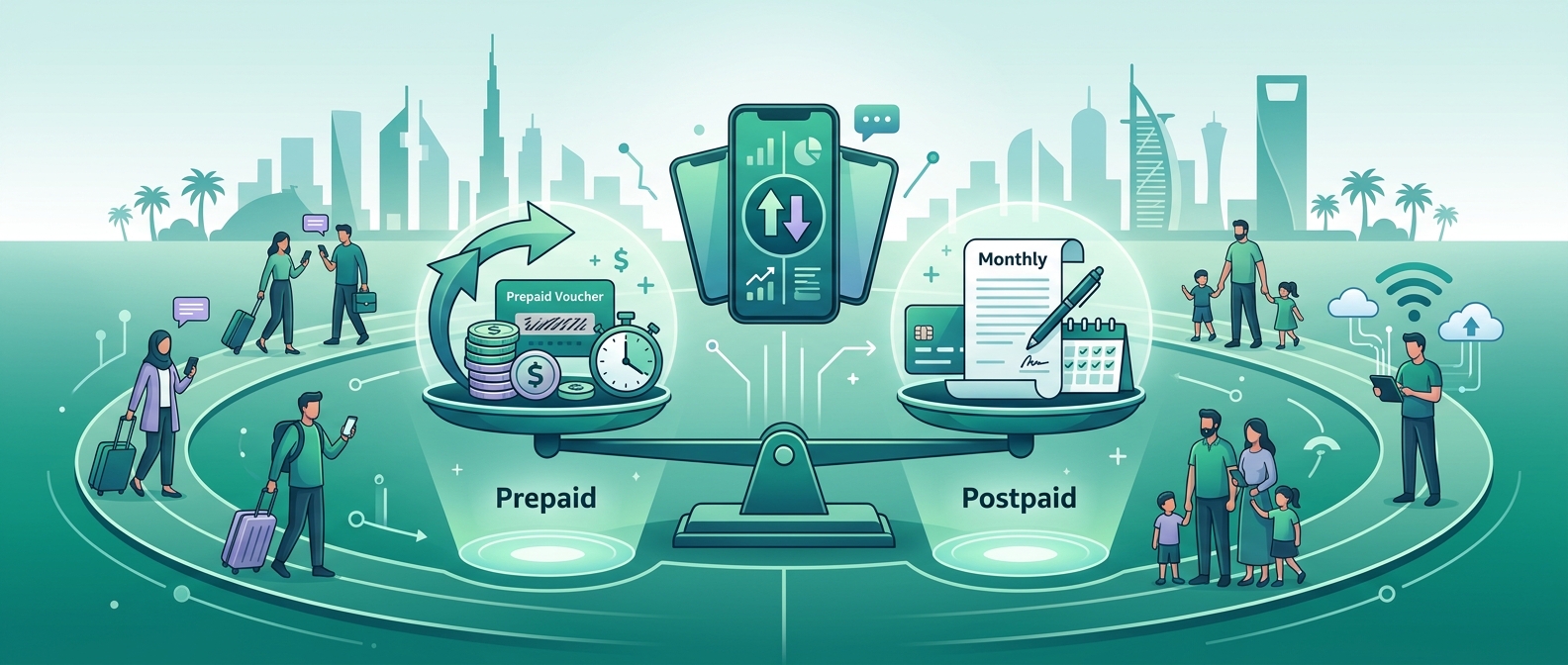
Prepaid suits new arrivals and light users. A SIM pack costs around AED 50-60, and typical monthly data bundles run from around AED 50 for a few GB to AED 100-200 for 20-40GB with some flexi minutes. No credit checks, no contract, but per-GB it is the most expensive way to buy data long term.
Postpaid requires an Emirates ID and sometimes a salary or credit check. Entry plans start around AED 100-150 per month for a decent data allowance and national minutes; mid-tier plans around AED 200-350 add large or unlimited data buckets, international minutes and roaming perks. Contract plans bundled with a flagship phone push totals higher. Watch for:
- 12-month commitments with early-exit fees on promotional pricing
- 5% VAT shown separately on some advertised prices
- Data throttling rather than hard cut-offs on "unlimited" plans
Virgin Mobile sits between the two models: month-to-month, cancel anytime, and often the cheapest way to get a large data bundle if you do not need a physical store. For a plan-by-plan breakdown, see our comparison of UAE mobile plans.
Home internet: your building chooses for you
The biggest surprise for newcomers: most buildings are wired for only one fibre provider, either e& or du. Before signing a lease, ask the landlord or building management which network serves the building, because you generally cannot pick the other one. (A growing number of buildings are dual-wired, and in some areas you can take a home wireless plan from either provider regardless.) Our home internet guide compares the providers and speed tiers in detail.
Typical 2026 pricing:
- Entry fibre (around 250-500 Mbps): roughly AED 300-400 per month, often bundled with a landline and basic TV
- Faster tiers (1 Gbps and up): roughly AED 400-700+ per month
- 5G home wireless (plug-in router, no fibre install): often AED 200-300 per month, the usual money-saver for tenants who do not need symmetrical fibre
Getting installed:
- Sign up online or in-store with your Emirates ID and your Ejari/tenancy contract (or title deed).
- Book the installation slot, usually within a few working days; the technician brings the router.
- Expect an installation/activation fee of around AED 100-200, frequently waived on promotions.
- Note the contract term: 12-24 months is standard, and cancelling early typically costs a month's fee or the remaining discount value. Ask about "no-commitment" variants if your lease is short.
When you move within the UAE, both providers offer free or cheap relocation of your line, which is far cheaper than cancelling and re-signing.
The VoIP situation: why WhatsApp calls don't work
Voice and video calls on WhatsApp, FaceTime and most mainstream apps are blocked on UAE networks (messaging and media work normally). This is a licensing regime, not a technical fault. Legal alternatives:
- BOTIM, the most popular licensed calling app; access is sold as an add-on ("internet calling plan") from around AED 50-100 per month for individuals or families, often bundled free with home internet or premium mobile plans
- Other licensed apps such as C'Me and HiU, plus business tools like Zoom, Microsoft Teams, Google Meet and Webex, which work for meetings
Some regular Skype/WhatsApp calling occasionally works on certain connections, but it is not something to rely on. Using VPNs specifically to bypass VoIP blocking sits in a legal grey-to-prohibited zone under UAE cybercrime rules; see our guide to what VPN use is actually legal. Most long-term residents simply budget for a calling plan.
eSIMs
All three brands support eSIM for both new lines and conversions, usually for a small fee of around AED 25-50 (often free in-app). A dual-SIM setup (a home-country eSIM for banking OTPs plus a UAE line) is the standard expat configuration and worth arranging before you cancel anything back home.
How to cut your costs
- Check the provider apps weekly, both e& and du push app-only flash bundles that are far cheaper than standing rates
- Bundle mobile + home internet with one provider for loyalty discounts and free calling-app add-ons
- Consider 5G home wireless instead of fibre if you mostly stream and browse
- Downgrade after the promo period, intro pricing quietly steps up after 3-6 months; a call to retention often restores the discount
- Students, seniors and people of determination qualify for discounted social packages, ask in-store
Before you sign a tenancy contract, send the building name to both providers' support chats and ask who serves it. Two minutes of checking can save you a year on the slower, pricier network.