You have a UAE job offer, or you are close to one. The good news first: your employer sponsors your work visa by law and pays for it. You apply for nothing yourself, and charging you recruitment or visa fees is illegal under UAE labour law.
Your part is small but time-sensitive: supply documents quickly, attend a medical test and a biometrics appointment, and check your contract before signing. Still searching? Start with our guide to finding a job in the UAE in 2026 and browse live roles on JobXDubai.
Who does what
Your employer's PRO (public relations officer) drives the whole process through MOHRE (Ministry of Human Resources and Emiratisation) and the immigration authority: GDRFA in Dubai, ICP federally. Free zone companies run the same steps through their free zone authority instead.
You supply: passport copy (valid 6+ months), passport photos, attested degree certificate for skilled roles, and sometimes a police clearance. Get the degree attested before you leave home; doing it later takes longer and costs more.
The process, step by step
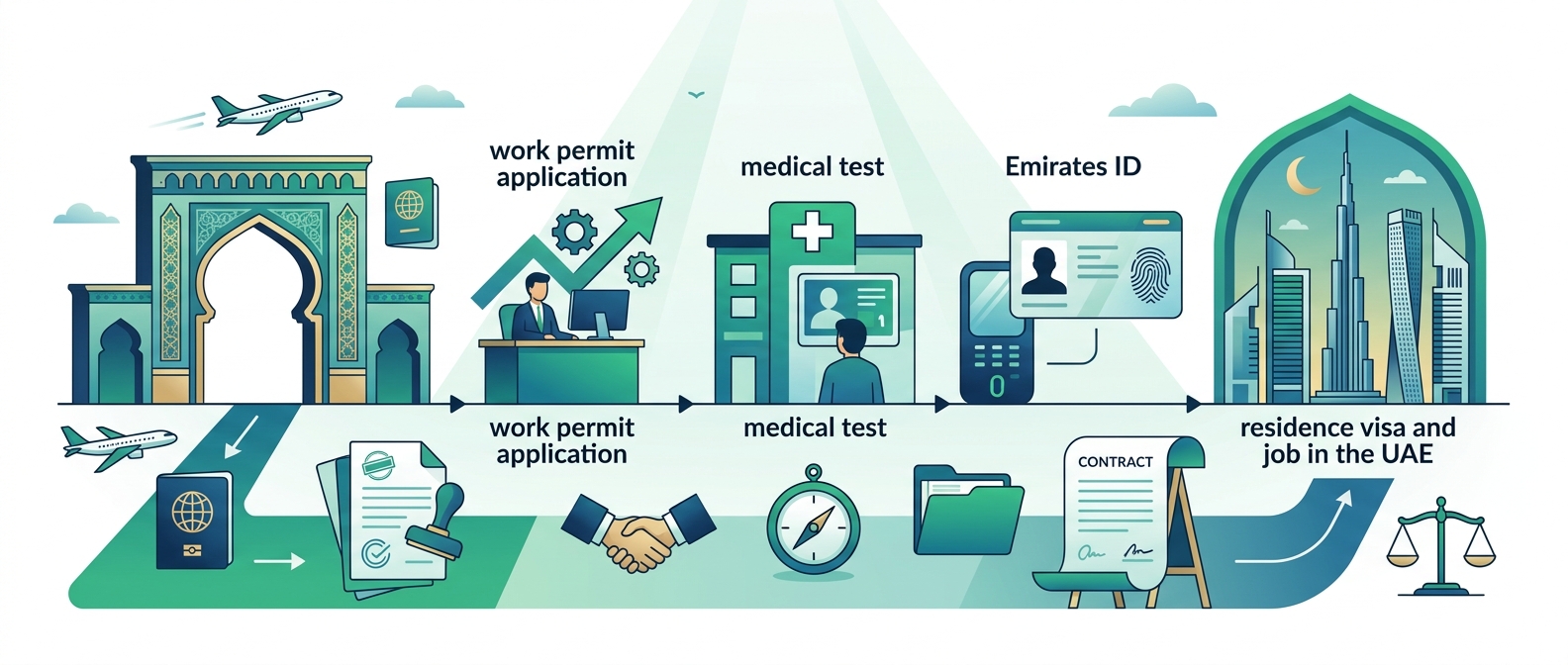
- Offer letter and work permit approval. You sign the offer, then the employer applies for MOHRE work permit approval; quota and Emiratisation checks happen here, on their side.
- Entry permit. If you are abroad, an electronic entry permit is issued and you fly in on it. Already in the UAE on a visit or job seeker visa? The employer does an in-country status change instead; no exit needed.
- Medical fitness test. Blood test and chest X-ray at an approved centre, results in one to three days with paid fast-track options, roughly AED 300 to 700, paid by the employer.
- Emirates ID biometrics. Fingerprints and photo at an ICP or Amer centre, needed only for your first UAE residency.
- Labour contract. The MOHRE contract must match your offer letter exactly: salary breakdown, job title, notice period. All contracts are limited-term since the 2022 labour law, and gratuity and many visa thresholds run off the basic salary line, so read the split carefully.
- Residence visa issuance. Once medical and biometrics clear, the visa is issued digitally (no passport sticker any more) and your Emirates ID card follows by courier or collection.
Timeline and costs
From landing to residence visa typically takes two to three weeks when the employer moves quickly. Residency formalities must be completed within 60 days of entering on the entry permit, so chase your PRO if things stall.
The employer covers work permit, entry permit, medical, Emirates ID and issuance fees, usually a few thousand dirhams in total. Any employer asking you to pay these costs is breaking the law, and you can report it to MOHRE.
Private-sector residence visas usually run two years. While yours is in process you can already sort a SIM and short-term housing; our first 30 days in Dubai checklist covers the right order.
Mainland vs free zone
The steps look identical from your side, but the paperwork runs through different systems. Mainland employees are on MOHRE contracts with full labour law coverage; free zone employees sign the zone's contract template, and most zones mirror the federal law closely. Worth checking: which entity sponsors you, and whether the visa runs two or three years. Family sponsorship works the same either way; see our family sponsorship guide.
When you leave or change jobs
When you resign or are terminated, the employer cancels your permit and visa, which triggers a grace period to stay legally, switch sponsor or exit. Read our guide to grace periods after cancellation before handing in notice. Switching jobs never requires leaving the country: the new employer runs the same process with an in-country status change, and there is no labour ban for a properly completed notice period.
Key takeaway
Your UAE employer sponsors and pays for your employment visa by law; your only jobs are to hand over documents fast, pass the medical and biometrics within 60 days of entry, and check that the MOHRE contract matches your offer letter before signing. Everything else is the PRO's problem.
FAQ
How long does a UAE employment visa take in 2026?
Typically two to three weeks from entry to residence visa, if the employer's PRO moves promptly. The legal window to complete formalities is 60 days from entering on the entry permit.
Do I have to pay for my own work visa in the UAE?
No. The employer pays all visa, permit and medical costs by law, and recruitment fees charged to employees are illegal. If an employer asks you to pay, treat it as a serious red flag and report it to MOHRE.
Can I start working before the visa is issued?
Once the work permit is approved and your status is adjusted, yes, and that happens early in the process. Working on a tourist or visit visa with no permit in process is illegal for both sides.
Do I need my degree attested?
For most degree-level roles, yes. Attest it in your home country through the UAE embassy chain before you travel; arranging it remotely later is slower and more expensive.
What happens to my visa if I lose my job?
The employer cancels the visa and a grace period starts, usually 30 to 180 days depending on category. Inside that window you can find a new sponsor, switch to a job seeker or Green Visa, or exit without penalty.