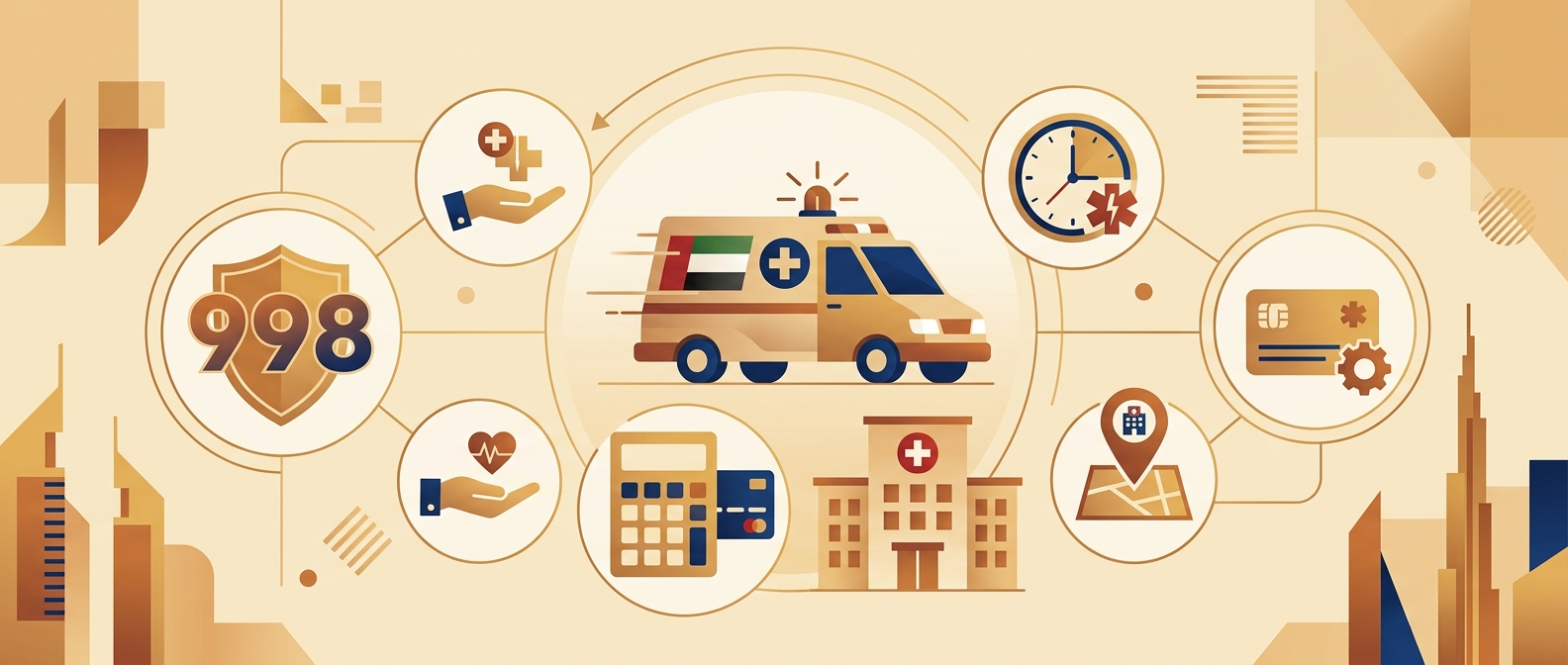
Save two numbers in your phone right now: 998 for an ambulance and 999 for police. In a real emergency you will not have time to search for them, and the person next to you may not know them either.
The second thing to know is just as important: no hospital in the UAE can refuse you emergency treatment, whether you have insurance, the right insurance, or none at all. Stabilising care comes first; paperwork and billing come after.
Here is how the emergency system works, where to go, and what it costs.
The numbers that matter
- 998: ambulance and medical emergencies, nationwide
- 999: police, and the general emergency line (they can dispatch an ambulance too)
- 997: fire (Civil Defence)
- 901: Dubai Police non-emergency line, for anything that does not need lights and sirens
Operators speak English and Arabic. If you are calling for someone else, lead with the location: area, street, building, and a landmark. Dubai ambulances use GPS but a clear address saves minutes.
For anything urgent but not life-threatening, a hospital emergency department or an urgent care clinic in your insurance network is usually faster and cheaper than an ambulance. Our guide to finding a GP or specialist in Dubai covers the everyday side of the system.
Call 998 or drive? A quick decision rule
Call 998 when there is chest pain, difficulty breathing, heavy bleeding, suspected stroke, serious trauma, loss of consciousness, or any situation where moving the person could cause harm. Paramedics start treatment on scene and the crew decides the receiving hospital.
Drive, or take a taxi, when the person is stable and mobile: cuts needing stitches, suspected fractures with the limb supported, high fever, moderate allergic reactions. You choose the hospital, which means you can pick one in your network.
- If in doubt, call 998 and describe the situation. The operator will tell you whether to wait for a crew.
- Never drive yourself if you have chest pain, dizziness or blurred vision.
- For road accidents, call police on 999 first; a police report is required for insurance claims.
Where to go: government and private emergency rooms
Both government and private hospitals run 24-hour emergency departments, and both must treat genuine emergencies.
- Government hospitals (for example Rashid Hospital in Dubai, the emirate's main trauma centre) handle the most serious cases and receive most ambulance traffic.
- Private hospitals with full emergency departments are spread across every major area, and waiting times for moderate cases are often shorter.
If your condition allows a choice, go where your insurance has direct billing. If it does not allow a choice, go to the nearest emergency room and let the hospital sort authorisation later. Under UAE rules, emergency treatment cannot be delayed for payment or approval.
What it costs
With a compliant policy, emergency treatment is covered on all plan levels, including the Dubai Essential Benefits Plan. You may still owe a co-pay, and follow-up care after discharge reverts to your normal network rules. How those pieces fit together is explained in our UAE health insurance guide.
Rough figures to calibrate expectations, all worth confirming with the provider:
- Ambulance transport: often charged separately from treatment, typically a few hundred dirhams. Some insurance plans cover it, some do not.
- Emergency room attendance without insurance: from around AED 300 to 1,000+ for assessment and basic treatment at private hospitals, rising quickly with imaging or admission.
- Admission without insurance: thousands of dirhams per night. The hospital will treat you first, then bill you, and unpaid medical bills can follow you.
If you believe your employer has left you uninsured, that is a breach you can report. See our guide to health insurance employee rights.
Key takeaway
998 for ambulance, 999 for police, and no UAE hospital can turn away an emergency. Save the numbers, know your nearest emergency department in and out of network, and let treatment come before paperwork. The system is built to respond fast; your job is only to call fast.
FAQ
What is the ambulance number in Dubai?
998, everywhere in the UAE. 999 (police) also works and can dispatch medical help. Operators handle calls in English and Arabic.
Can a hospital refuse me if I have no insurance?
Not for an emergency. UAE rules require hospitals to stabilise and treat emergency cases regardless of insurance or ability to pay. You may be billed afterwards, but treatment comes first.
Do I pay for an ambulance in the UAE?
Emergency response comes when called, but transport usually carries a charge of a few hundred dirhams, billed later. Some insurance plans reimburse it; check yours and confirm current fees with the ambulance service in your emirate.
Where is the main emergency hospital in Dubai?
Rashid Hospital is Dubai's main government trauma centre, and most serious ambulance cases go there. Many private hospitals across the city also run full 24-hour emergency departments.