Ruby is the best-known virtual receptionist brand in the market, and it prices like it. The entry plan is $250 a month for 50 minutes, which works out at $5.00 per minute if you use the whole allowance, and considerably more if you do not.
That is not necessarily bad value. Ruby staffs live receptionists around the clock with no setup, activation or onboarding fees, and for some businesses that is worth the premium. But it is a high enough number that it is worth knowing what else exists.
What Ruby actually charges
| Plan | Monthly | Included minutes | Effective rate at full use |
|---|---|---|---|
| Starter | $250 | 50 | $5.00/min |
| Basic | $395 | 100 | $3.95/min |
| Popular | $720 | 200 | $3.60/min |
| Enterprise | $1,725 | 500 | $3.45/min |
Live chat is priced separately at $143 to $520 a month, discounted 20% when bundled with a receptionist plan.
Two things Ruby does not publish: an overage rate, so you cannot model what a busy month costs, and a free trial, so the first commitment is a full month. Both are worth weighing against services that publish one or offer the other.
When Ruby is the right answer anyway
Your first call is the sale. For high-ticket professional services, a caller who reaches a warm, well-briefed person converts at a rate that makes $5 a minute irrelevant. If one won client pays for a year of Ruby, stop optimising the line item.
You want zero operational involvement. Ruby's pitch is that it handles everything with no configuration burden. Cheaper services, especially the AI ones, need you to write the knowledge base and set the escalation rules. That setup work is real.
Your callers must never hear software. Some client bases will simply not tolerate it. You know if yours is one of them.
The seven alternatives
1. PATLive — the same product, roughly half the price
Live US-based receptionists, 24/7, explicitly no AI. Eleven tiers from $49 pay-as-you-go at $2.99 a minute up to $6,899 for 5,000 minutes, with every overage rate published and a 14-day free trial on every plan.
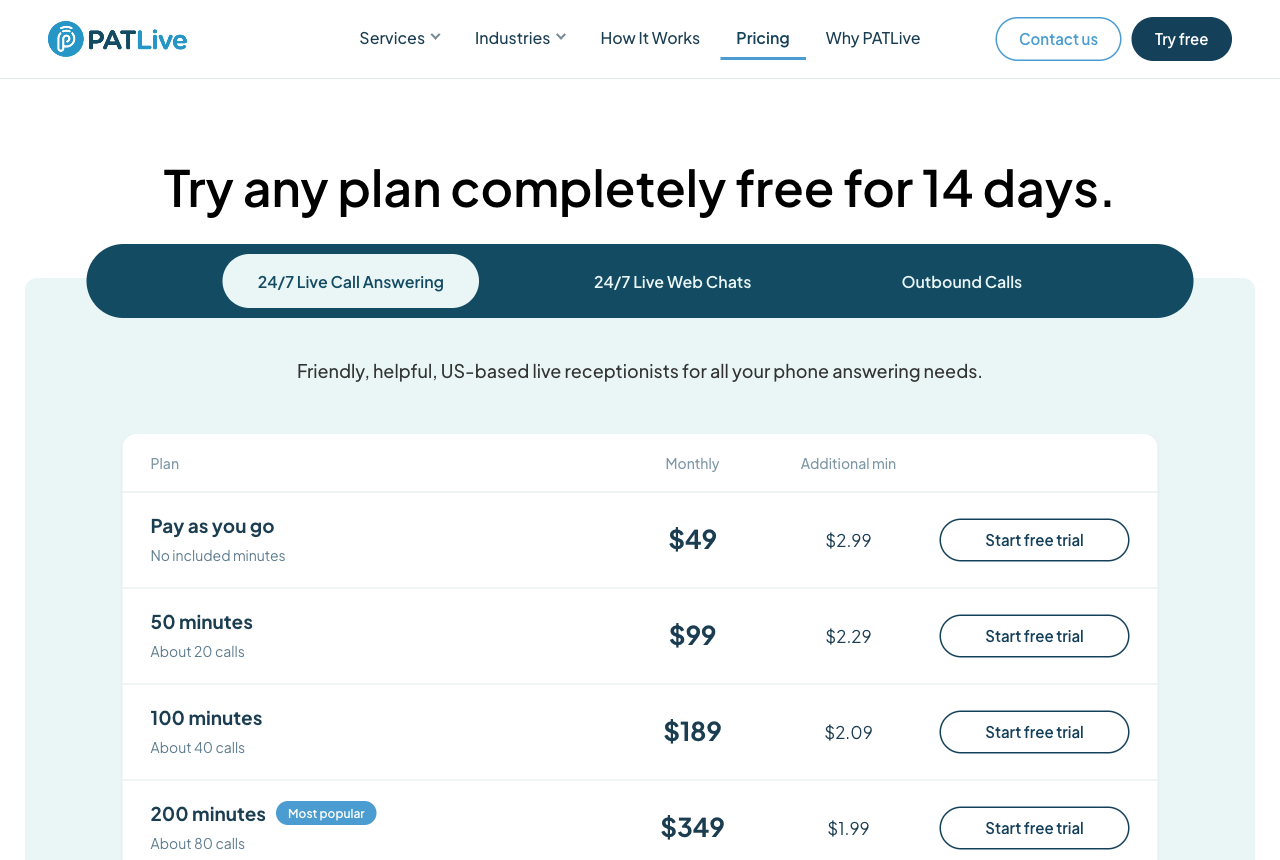
At 200 minutes, PATLive is $349 against Ruby's $720. That is an effective $1.75 a minute versus $3.60, for the same category of service. The published rate card and the trial are both things Ruby does not offer.
The catch: PATLive does not publish its billing increment, which is the one figure that can quietly move an effective per-minute rate. Ask before signing.
Best for anyone who wants Ruby's product without Ruby's premium.
2. Abby Connect — human, with AI to stretch the allowance
$165 for 50 minutes, $329 for 100, $599 for 200, $1,380 for 500. No setup fee, month-to-month, free trial on every plan.
The distinctive mechanic: a human minute consumes one "Abby Minute", an AI-handled minute consumes half. If routine calls can be handled by software, your allowance goes twice as far.
At the 50-minute entry point Abby is $165 against Ruby's $250, and it gives you a trial.
Best for businesses with a mix of routine and complex calls.
3. Smith.ai — human tiers with AI in front
Two products. The human Virtual Receptionist tiers run $300 for 30 calls, $810 for 90 and $2,100 for 300. The AI Receptionist tier starts at $0 for 25 calls, then $3.00 each.
Smith.ai's real advantage over Ruby is the hybrid: AI answers first and escalates to Smith.ai's own North America-based receptionists when a call turns complex. You pay software rates on routine calls and human rates only where it counts. Its Clio, HubSpot and Salesforce integrations are also deeper than Ruby's.
Note that Smith.ai bills per call while Ruby bills per minute, so which is cheaper depends entirely on your average call length.
Best for professional services already running on Clio or Salesforce.
4. AnswerConnect — human, but you will have to ask
Live agents with 24/7 coverage and bilingual Spanish included at every tier. Pricing is form-gated; the public pricing page returns a 404. Third-party 2026 reviews place it around $179 to $399 a month for 100 to 300 minutes with $1.75 to $2.50 overage, but those are other people's figures.
Best for buyers willing to negotiate. Treat any published number as unverified until quoted.
5. Rosie — the cheapest credible AI plan
$49 for 250 minutes, $149 for 1,000, $299 for 2,000. Seven-day trial, two months free annually, bilingual English and Spanish, native mobile apps.
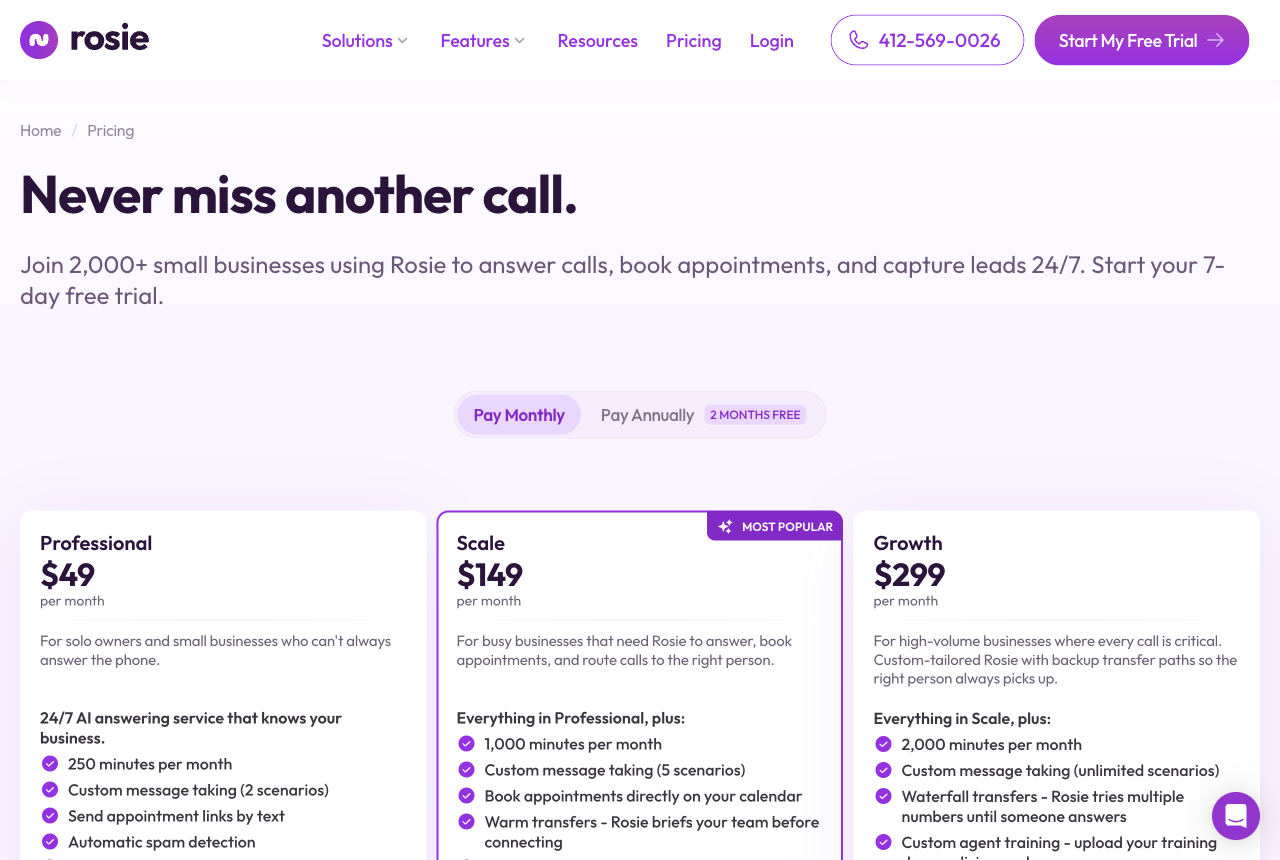
At 200 minutes, Rosie is $49 against Ruby's $720. That is not a like-for-like comparison, because software is answering rather than a person, but for businesses whose calls are mostly hours, prices and bookings, the gap is difficult to justify away.
Best for routine call volume where a person is not required.
6. Dial Milo — no plan at all
Per-second pay-as-you-go at roughly 6¢ a minute, no subscription and no monthly minimum. A number is $3 a month, or forward your existing line free.
At 200 minutes that is about $15 a month. The structural difference from every plan on this page is that a quiet month costs nothing, and calls that are never answered cost nothing at all.
What you give up against Ruby is everything a person provides: no human takeover, no reading of tone, no judgement on an unusual call.
Best for unpredictable volume where cost should track usage exactly.
7. Dialzara — predictable AI plans
$29 for 60 minutes, $99 for 220, $199 for 500, $349 for 1,000, with published overage rates from 48¢ down to 35¢ a minute and a seven-day trial.
Best for anyone who wants a fixed monthly figure and an overage rate they can actually see.
Cost at three volumes
| Service | 45 minutes | 200 minutes | 600 minutes |
|---|---|---|---|
| Dial Milo | $5.70 | $15.00 | $39.00 |
| Rosie | $49.00 | $49.00 | $149.00 |
| Dialzara | $29.00 | $96.20 | $239.00 |
| PATLive (human) | $99.00 | $349.00 | $938.00 |
| Abby Connect (human) | $165.00 | $599.00 | not priceable |
| Ruby (human) | $250.00 | $720.00 | not priceable |
Ruby is the most expensive option at every volume where it can be priced at all.
Key takeaway
Ruby's entry plan works out at $5.00 a minute, roughly double PATLive's rate for the same live-receptionist service. If you want humans, PATLive at $349 for 200 minutes does the same job as Ruby's $720 plan and publishes both a full rate card and a 14-day trial. If your calls are mostly routine, AI services cover the same volume for $15 to $49. Stay with Ruby if a caller reaching a warm human is the thing that closes your business.
FAQ
How much does Ruby Receptionists cost?
Virtual receptionist plans are $250 for 50 minutes, $395 for 100, $720 for 200 and $1,725 for 500 a month. Live chat is separate at $143 to $520, discounted 20% when bundled. Ruby does not publish an overage rate or offer a free trial.
What is the cheapest alternative to Ruby?
For a human service, PATLive at $49 pay-as-you-go or $349 for 200 minutes, roughly half Ruby's rate. For an AI service, per-second pay-as-you-go at about 6¢ a minute, or Rosie at $49 for 250 included minutes.
Is Ruby worth it compared to an AI receptionist?
It depends what share of your calls need judgement. If most are opening hours, prices and bookings, AI handles them at a fraction of the price. If callers arrive confused, upset or ready to spend a lot, a trained person converts them better and Ruby is a defensible cost.
Does Ruby offer a free trial?
No free trial is published on Ruby's pricing page. PATLive offers 14 days on every plan, Abby Connect offers a trial on every plan, and Dialzara and Rosie each offer seven days.
Does Ruby charge for spam calls?
Ruby does not publish how spam and wrong numbers are handled, so ask before signing. Smith.ai explicitly does not charge for them. Per-second services bill nothing for a call that is never answered.